Car Detailing Tips 02
Keeping your car looking its best doesn’t always require a full detail. Regular washing, removing contaminants early and using the right products…
Read Article

Short answer: Yes, many can. If the scratch sits within the clear coat, machine polishing removes it or dramatically reduces it with no repaint needed. If it has gone through to the colour coat, primer or bare metal, polishing cannot replace what is missing. Depth decides it, and there is a ten-second test you can do on your driveway.
Finding a fresh scratch doesn’t mean the panel needs repainting. In a lot of cases, it doesn’t come close. Understanding why means knowing how thin modern car paint actually is.
A painted panel is several layers, and they’re thinner than most people expect. Primer sits on the panel and gives the colour something to bond to. Base coat carries the colour. Clear coat, sometimes called lacquer, sits over the top and provides the gloss and the protection.
Almost every defect you notice during normal ownership lives in that top clear layer. It’s also the only layer that can be worked on without repainting.
Machine polishing refines that clear coat, removing an extremely thin amount of it around a defect until the surface is level enough to reflect light cleanly again. The scratch isn’t filled or covered. The paint around it is brought down to meet it. That’s the opposite of glazes and filler-heavy products, which sit in the defect and wash out within a few weeks.
Before you call anyone, do this. Run a clean fingernail gently across the scratch, at right angles to it rather than along its length.
If your nail glides over without catching, the scratch is very likely within the clear coat. That’s the type of machine polishing handles well.
If your nail catches firmly, the scratch has broken through the clear coat. Polishing will reduce how obvious it is and clear the haze around it, but the scratch itself will remain.
It isn’t infallible. Scratches vary in depth along their length, so check at several points, and different paint systems behave differently. But it tells you within seconds whether you’re looking at a surface defect or genuine paint damage, and it makes for a far more useful conversation when you get in touch.
Polishing refines paint that’s there. It can’t recreate paint that’s gone. These need a body shop:
Paint correction is very effective on the right defects. It isn’t a substitute for a repaint where paint is genuinely needed, and we’ll tell you if that’s what you’re looking at rather than take money for work that can’t deliver.
More stages isn’t automatically better. If your car has light scratches or swirl marks, mention them when you enquire, because a two- to three-stage machine polish may be needed and it’s better to establish that beforehand. What that means for price is covered in our guide to what affects paint correction cost.
Because clear coat is finite and it doesn’t come back. Every polishing stage removes a small amount permanently. That’s precisely why it works, and precisely why there’s a limit to how far any defect should be chased.
Removing more and more clear coat to eliminate the last trace of a deep scratch risks a far worse outcome than the scratch itself. Sometimes the right answer is to substantially reduce a mark rather than pursue its complete removal. Good correction is as much about knowing when to stop as knowing how to polish, and you’ll be told which situation your car is in before work starts.
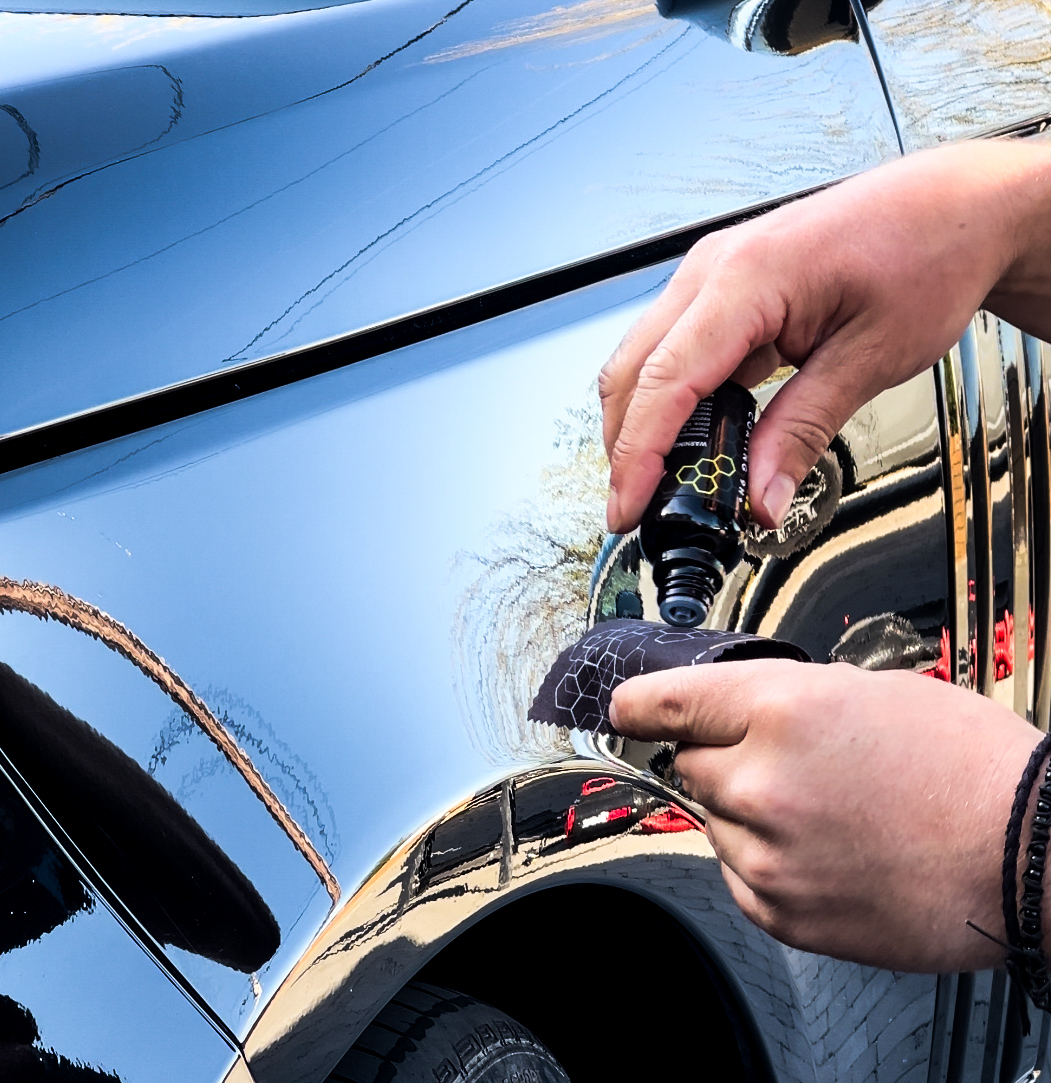
Once corrected, the paint is bare. Applying protection preserves the work and makes future maintenance easier. Body Armour Ceramic provides up to three years, creating a hydrophobic surface that repels water, dirt and grime while holding gloss. Body Armour Graphene, our premium option, provides up to five years with 10H hardness, high UV and chemical resistance, and suitability for paint, wraps, wheels, lights, plastic trim and carbon fibre.
Neither makes paint scratch-proof. What they do is take the wear that would otherwise land on your clear coat. For the full picture on durability, see how long ceramic coating lasts.
A scratch that has genuinely been corrected doesn’t come back, because the surface was refined rather than temporarily filled. New ones can still be introduced. Automatic brush washes, dirty mitts and contaminated drying towels will mark corrected paint exactly as they marked it the first time. Hand washing with two buckets and clean equipment is what preserves the work, and regular mobile valeting is a safe way to keep on top of it.
Everything is done where your car is parked, at home or at work, and we arrive self-contained. We cover 50 towns across 15 counties in the North West, Midlands, Yorkshire and North Wales, including Cheshire, Greater Manchester, Lancashire, Merseyside, West Midlands, Staffordshire and West Yorkshire. The full list is on our locations page, and heavier corrective work sits within our mobile detailing service.
Only where the damage stays within a workable part of the clear coat. Once a scratch reaches the colour coat, primer or metal, polishing cannot replace what’s missing.
Yes, in the sense that the surface has been genuinely refined rather than filled. New scratches can still be introduced later through poor washing.
Swirl marks are one of the defects machine polishing handles best. Our major paint correction detail is specified at around a 95% reduction.
Yes, and correcting first is the right order. Coating over defects preserves them for years, because a coating is optically clear. If the car is new, we’ve looked at whether it is worth coating a new car.
Our graphene coating air-dries in around an hour and reaches full cure in about twelve. The car needs to stay dry through that window, which is worth planning for with mobile work.
If scratches or swirl marks are spoiling how your car looks, the first step is establishing what’s realistically achievable. Do the fingernail test, take a couple of daylight photos at an angle where the marks catch the light, and send those with your postcode and where the car is parked. We’ll tell you honestly what can be corrected, including when the answer is less work than you were expecting. Call 01829 701 846 or message us on WhatsApp.